

Where washer failures land on the cost scale
A washer that stops with a tub full of water feels like a disaster, but standing water is one of the most common and least serious things a washer does. A machine that still runs yet howls on every spin sounds like a nuisance, and it can be the more expensive story. Put the failure in a band before you judge the whole machine. From the lowest band to the highest:
- The cheapest kind of repair: a sock or coin jammed in the pump filter, a kinked drain hose, a clogged inlet screen, a lid switch or door strike that no longer closes the circuit.
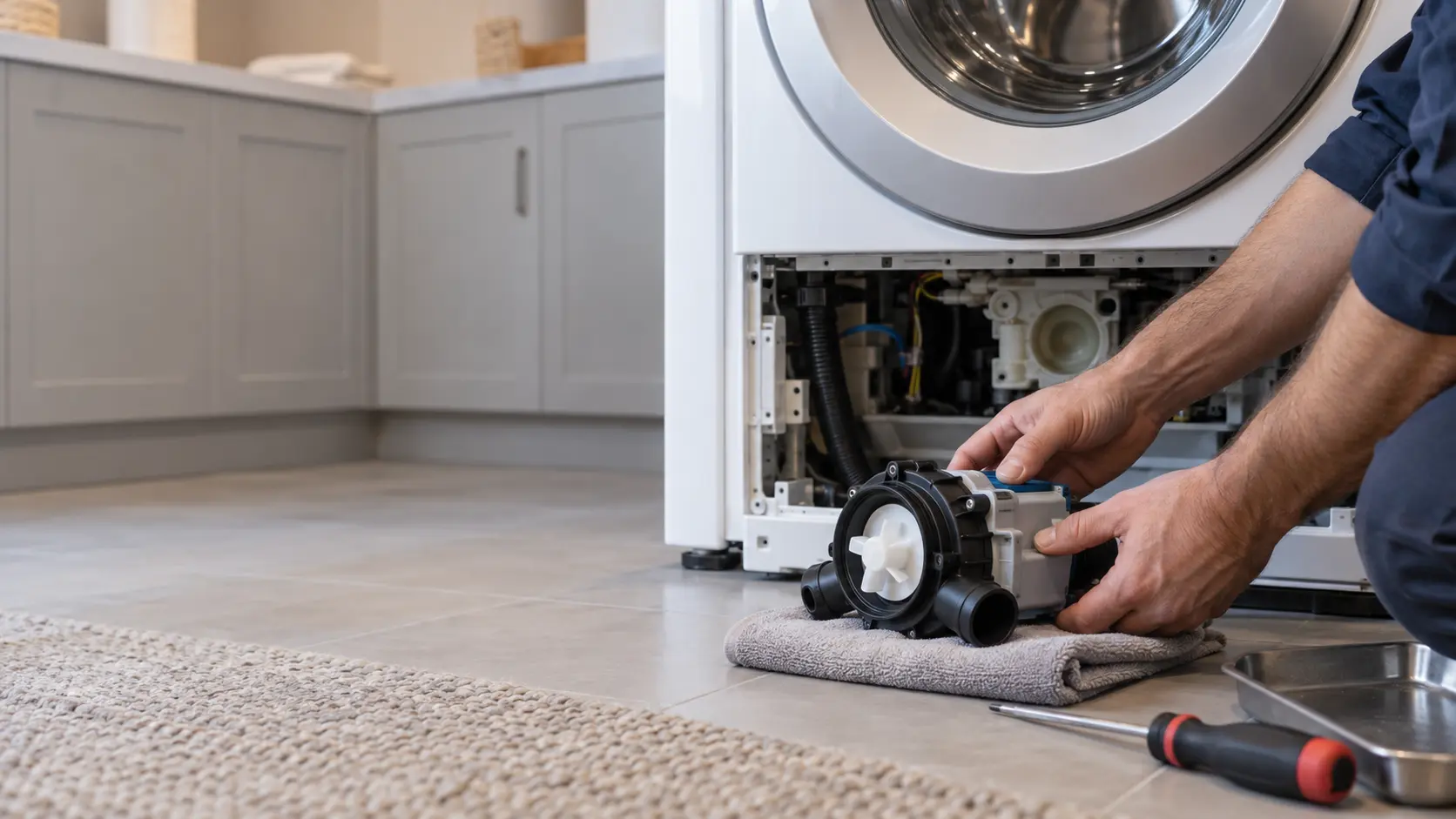
- The low band: a drain pump motor, a water inlet valve, a door lock assembly, a torn door boot, a worn belt on a belt-drive model.
- Moderate: a drive motor or its motor control board, a main control board, a set of suspension rods or shocks with their mounting parts, a pressure sensor and its tubing.
- The top of the scale: drum bearings and the rear tub seal on a front-loader, a cracked outer tub, a failed transmission or a worn clutch on an older agitator top-loader.
Standing water is not a verdict
When a washer ends a cycle full, the first suspects are the pump filter, the drain hose and the height of the standpipe connection. Only after those are ruled out does the pump motor itself come into it, and even a new pump sits in the low band. Bailing the drum and opening the filter is worth doing before any talk of a new machine.
When the machine shakes itself across the floor
Violent shaking points owners toward replacement faster than any other symptom. Most of the time the cause is a load bunched to one side, a washer standing on three feet, or shipping bolts that were never removed. Worn shocks or suspension rods come next, and they are a moderate job, not the end of the washer.
Signs a washer is finished
A few findings make almost any washer a poor candidate for further money. They tend to show up together on machines that have spent years spinning heavy or unbalanced loads.
- A grinding roar during the spin, with rust-colored streaks running down the back of the outer tub, on a front-loader whose bearings are sold only with the tub.
- Water seeping from a crack in the outer tub itself rather than from a hose or a boot.
- A drum that rocks when you push its rim by hand, showing that the spider arm or the shaft behind it has worn or corroded.
- On an agitator top-loader, a transmission that leaks oil onto the floor or lets the agitator turn freely in both directions.
- A cabinet rusted through at the base from years of slow leaks, so the frame no longer holds the suspension square.
How the type of washer changes the answer
The same diagnosis leads to different decisions on different designs, because each one hides its expensive parts in a different place.
| Situation | Usual answer | Main reason |
|---|---|---|
| Any type, pump, valve, lock or switch | Repair | The part is modest and reached through a panel |
| Front-loader with failed bearings | Usually replace | The bearings often come only with a new outer tub |
| Top-loader past ten years, transmission | Lean replace | The labor and the part approach the cost of a new machine |
| Laundry center, washer half failing | Repair in most cases | A new unit means buying a dryer as well |
| Any type with a cracked outer tub | Replace | The tub holds every gallon the machine takes in |
Front-load washers
Front-loaders are generous about their common repairs: the pump sits behind a small panel at the bottom, and the door lock and boot come off from the front. Their weak point is the bearing pack at the back of the tub. Some makers sell the bearings separately and many do not, and that one detail usually decides whether a noisy front-loader gets a second life.
Top-load washers
Agitator and impeller top-loaders are simpler to open and to move. Lid switches, pumps, valves and shocks are all modest jobs. The expensive parts are the gearcase or the shifter on direct-drive designs and the transmission on older ones; on a machine past ten years, a failure there is usually where the money should stop.
Laundry centers and all-in-one machines
A one-piece laundry center puts the washer and the dryer on the same frame, so scrapping the washer half means scrapping the dryer above it. That pushes the decision toward repair unless both halves are tired. An all-in-one washer-dryer is the reverse case: a single drum does both jobs, so a failed washing part takes away the drying too.
Water and energy as a tiebreaker
Efficiency is rarely a reason to retire a washer that works, but it is a fair tiebreaker once a moderate or top-band estimate is in hand. ENERGY STAR says certified clothes washers use about 20 percent less energy and about 30 percent less water than regular models, and that a full-size certified washer uses about 14 gallons a load where a standard one uses about 20.
The biggest gap is between designs rather than between years. An old agitator top-loader replaced by a front-loader or an impeller model changes the water bill far more than one front-loader replaced by a newer front-loader. If the house has a well, a septic system or metered water, that difference carries more weight.
Source: ENERGY STAR — Clothes washers — Certified washers use about 20% less energy and 30% less water; a full-size certified washer uses about 14 gallons a load against about 20 for a standard one
Price the whole swap, not the showroom tag
A new washer arrives with costs that the old one had already paid. GE Appliances notes that since August 2010 its washers no longer come with fill hoses, apart from compact, unitized and commercial-style models, and GE recommends replacing hoses every five years anyway. Add delivery, removal of the old machine, a new drain hose if the old one is brittle, and a stacking kit or pedestal if the layout needs one.
The question to ask is what it takes to repair or replace a washer here, in this space, with these hookups. A narrow closet door, a basement stair or a second-floor laundry can turn a simple exchange into a two-person carry with the door removed.
Source: GE Appliances — Washer inlet fill hoses — Since August 2010 GE washers ship without fill hoses except compact, unitized and contract models; GE recommends replacing hoses every 5 years


