

What HE actually means
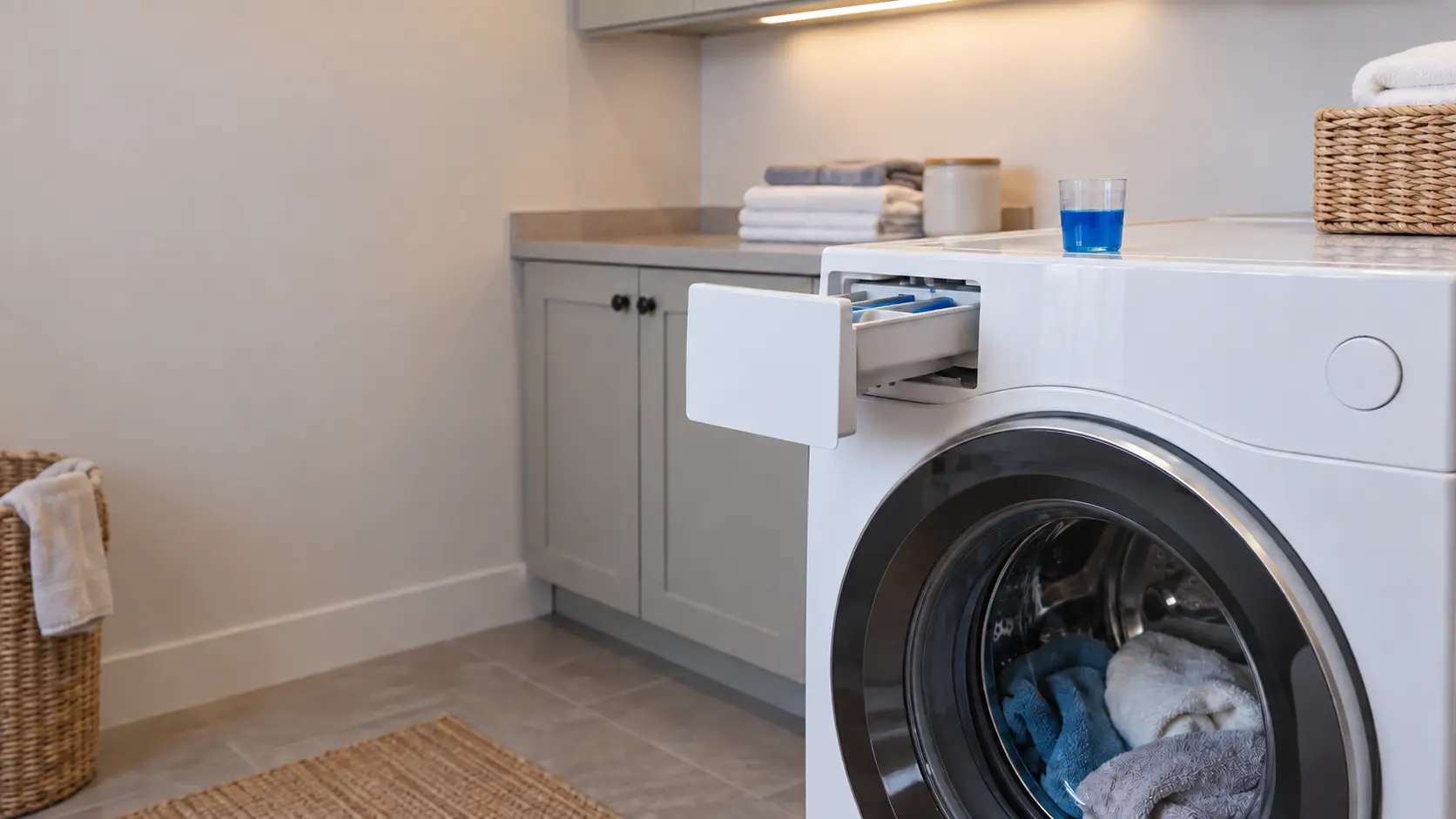
HE stands for high efficiency, and it describes both the washer and the detergent. An HE washer fills with a small amount of water and relies on tumbling or rolling the clothes. HE detergent is formulated to clean in that small volume while producing little foam, because foam cushions the clothes and makes the drop-and-tumble action far less effective.
Whirlpool's instruction is short: in a high-efficiency machine, use only HE detergent. Regular detergent can still clean, but it makes more suds than an HE washer can rinse out, and the leftover film is one of the reasons Whirlpool gives for washer odor. The HE symbol on a bottle is the quickest way to tell which kind you have.
Is my washer HE?
Front-loaders are HE by design, and so is nearly every top-loader with a low impeller instead of a tall agitator. Many newer agitator top-loaders are HE as well. The lid, the door frame or the manual will say so; when in doubt, treat the washer as HE.
Source: Whirlpool Product Help — HE detergent use in a washer — Use only HE detergent in HE machines; follow the detergent maker's dose by soil and load size; too much causes longer cycles, oversudsing, poor rinsing and cleaning; large pacs only for large or heavily soiled loads; replace detergent that does not dissolve; match the bulk dispenser concentration; Whirlpool Product Help — Removing odor or smell from a top-load washer — Non-HE detergent can leave a film residue that results in odor
Why overdosing is the usual mistake
Caps are large, pods are sized for big loads and old habits carry over from older washers. According to Whirlpool, too much detergent leads to longer cycles, oversudsing, poor rinsing and poor cleaning, and its guidance adds that the excess suds can make the washer spin more slowly, leaving loads very wet or setting off an error code. Signs you are using too much:
- Foam visible through a front-loader's door glass during the rinse.
- Towels that feel stiff or slippery, or dark clothes with a pale film.
- Cycles that run noticeably longer than the time shown at the start.
- A load that comes out heavy and dripping after the final spin.
- Suds or water around the dispenser or under the door on a front-loader.
Source: Whirlpool Product Help — HE detergent use in a washer — Use only HE detergent in HE machines; follow the detergent maker's dose by soil and load size; too much causes longer cycles, oversudsing, poor rinsing and cleaning; large pacs only for large or heavily soiled loads; replace detergent that does not dissolve; match the bulk dispenser concentration; Whirlpool Product Help — Excessive detergent or suds in a top-load washer — Very soft water may need less detergent; excess suds can reduce spin speed, leaving wet loads or error codes; no-splash or easy-pour bleach contains a thickener that may create excess suds

Reading the dose on the bottle
HE detergents are sold at different concentrations, commonly marked 2x, 4x or 8x. Whirlpool's guidance is to follow the detergent maker's dosage for the soil level and load size, which means the right amount changes whenever you change brands. The fill line on the cap for a medium load is often far below the top of the cap.
Water hardness moves the dose as well. Whirlpool notes that very soft water may call for less detergent. Homes with hard water may need the full amount, but that is a reason to measure carefully, not to pour freely.
Pods and packs
Single-dose pacs remove the measuring, but not the choice of size. Whirlpool says the larger pre-measured ones should only be used for large or heavily soiled loads. A pod never goes in the dispenser drawer unless the manual says so. Keep pods stored up high, closed and away from children.
Washers with a bulk dispenser
Some washers hold a bottle's worth of liquid HE detergent and meter it out each load. On Whirlpool models the concentration setting has to match the detergent in the reservoir; left on the wrong setting, the washer will dose too much or too little every load, so update it whenever you switch brands.
Old or clumped powder
Powder that has absorbed moisture dissolves poorly, especially in cold water. Whirlpool recommends keeping containers closed and replacing detergent that is not dissolving, rather than adding more to make up for it.
Source: Whirlpool Product Help — HE detergent use in a washer — Use only HE detergent in HE machines; follow the detergent maker's dose by soil and load size; too much causes longer cycles, oversudsing, poor rinsing and cleaning; large pacs only for large or heavily soiled loads; replace detergent that does not dissolve; match the bulk dispenser concentration; Whirlpool Product Help — Excessive detergent or suds in a top-load washer — Very soft water may need less detergent; excess suds can reduce spin speed, leaving wet loads or error codes; no-splash or easy-pour bleach contains a thickener that may create excess suds
Softener and bleach in an HE washer
Liquid fabric softener goes only in its own dispenser compartment, filled to the line and no higher; an overfilled compartment siphons early and leaves greasy spots. Bleach also belongs in its own compartment. Whirlpool warns that no-splash or easy-pour chlorine bleach contains a thickener that can create excess suds in washers, and suggests regular liquid bleach instead.
On a typical HE dispenser, each product has one place:
- Liquid or powder HE detergent in the main wash compartment, or in the drum if the manual says powder goes there.
- Pods loose in the empty drum, with the clothes loaded on top.
- Liquid chlorine bleach in the compartment marked for it, never poured straight onto dry fabric.
- Liquid softener in its own cup, which the washer releases during the final rinse.
Source: Whirlpool Product Help — Excessive detergent or suds in a top-load washer — Very soft water may need less detergent; excess suds can reduce spin speed, leaving wet loads or error codes; no-splash or easy-pour bleach contains a thickener that may create excess suds
Resetting a washer that has been overdosed
If the signs above sound familiar, cut back first and clean second. Run one or two empty rinse cycles with no detergent at all and watch for foam; suds that appear with nothing added are residue leaving the tub and the clothes. Then run the monthly cleaning cycle and restart with a measured dose.
Give the new dose a few weeks before judging it. Clothes washed for months in too much soap can hold residue that takes several washes to leave, and towels are usually the last to feel soft again. If whites still look dingy on the lower dose, try a warmer cycle or a heavy-soil setting before reaching for more detergent.


