Why fill hoses fail
A washer does not draw water the way a sink does. The supply valves on the wall stay open, and the washer's own inlet valve does the switching, so the hoses between them are pressurized around the clock. Every time the inlet valve snaps shut, a small pressure surge runs back through the hose as well.
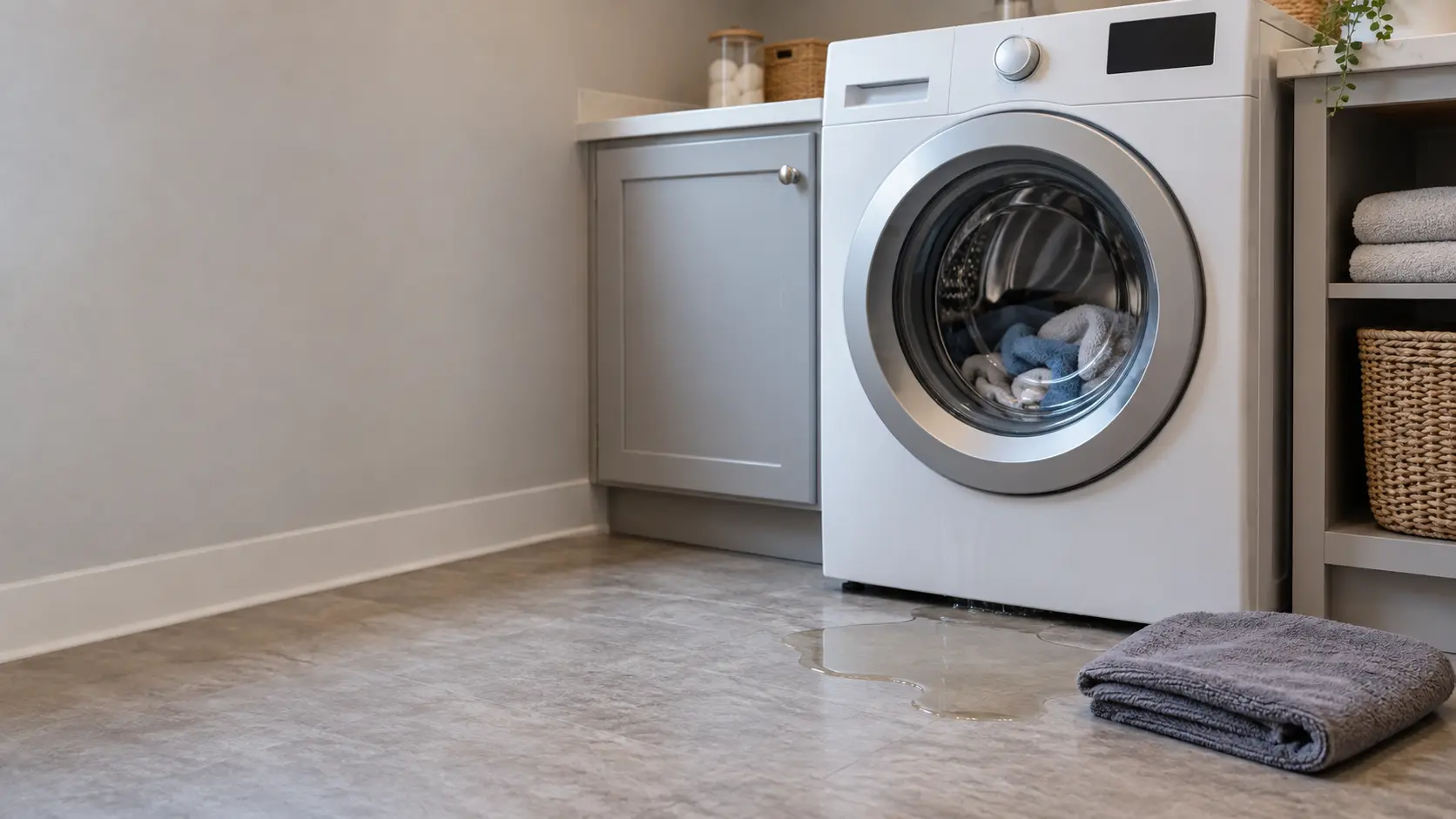
Rubber softens and cracks with years of heat and pressure, starting on the inside wall where no one can see it. The weak points are the crimped metal collars at each end and any tight bend behind the machine. A slow drip at a fitting is a warning; a split in the hose body can release water at the full rate of the supply until someone closes the valve.
Where the washer stands changes how much that matters. A washer in an unfinished basement near a floor drain can lose water for a while with little harm. A washer in a hallway closet, a second-floor laundry or an apartment above a neighbor sends the same water through ceilings and into walls, which is why hose age deserves the most attention in exactly the homes where the machine is hardest to see behind.
The five-year rule
GE Appliances recommends replacing washer fill hoses every five years, and Whirlpool's product help says the same. The interval is not tied to visible wear, which is the point: by the time a rubber hose looks bad, it has usually been weak for a while.
Most owners do not know how old their hoses are. If the washer came with the house, or the hoses came from an earlier machine, count them as due. A strip of tape on each hose with the install date written on it settles the question next time.
New washer, old hoses
GE notes that its washers stopped shipping with fill hoses in August 2010, except compact, unitized and contract models. Many installers reconnect whatever hoses were already on the wall, so a brand-new washer can be running on hoses much older than the machine.
Source: GE Appliances — Washer inlet fill hoses — Replace hoses every 5 years; hoses not included since August 2010 except compact, unitized and contract models; standard 4-foot hoses with 3/4-inch connections and stainless options; hot right, cold left facing the rear; check valves not recommended; Whirlpool Product Help — Checking the fill hoses if the washer is not filling — Fill hoses should be replaced every five years; clean clogged inlet screens with a brush and mild soap without removing them

What to look for between replacements
Pull the washer forward a few inches with the machine off, and look at both hoses along their length with a flashlight. Replace them now if you find any of these:
- A bulge or blister anywhere along the hose.
- Cracks or crazing in the rubber, especially near the collars.
- Rust, green corrosion or a white mineral crust at a fitting.
- A kink or a bend so tight that the hose flattens.
- Dampness, drips or water stains on the floor or the wall below the valves.
Braided or plain rubber
Hoses wrapped in a stainless braid resist kinks and punctures better than bare rubber, and GE sells both kinds. Under the braid there is still a flexible inner hose, so the braided type is not a reason to skip the inspection or the replacement interval.
Length and routing
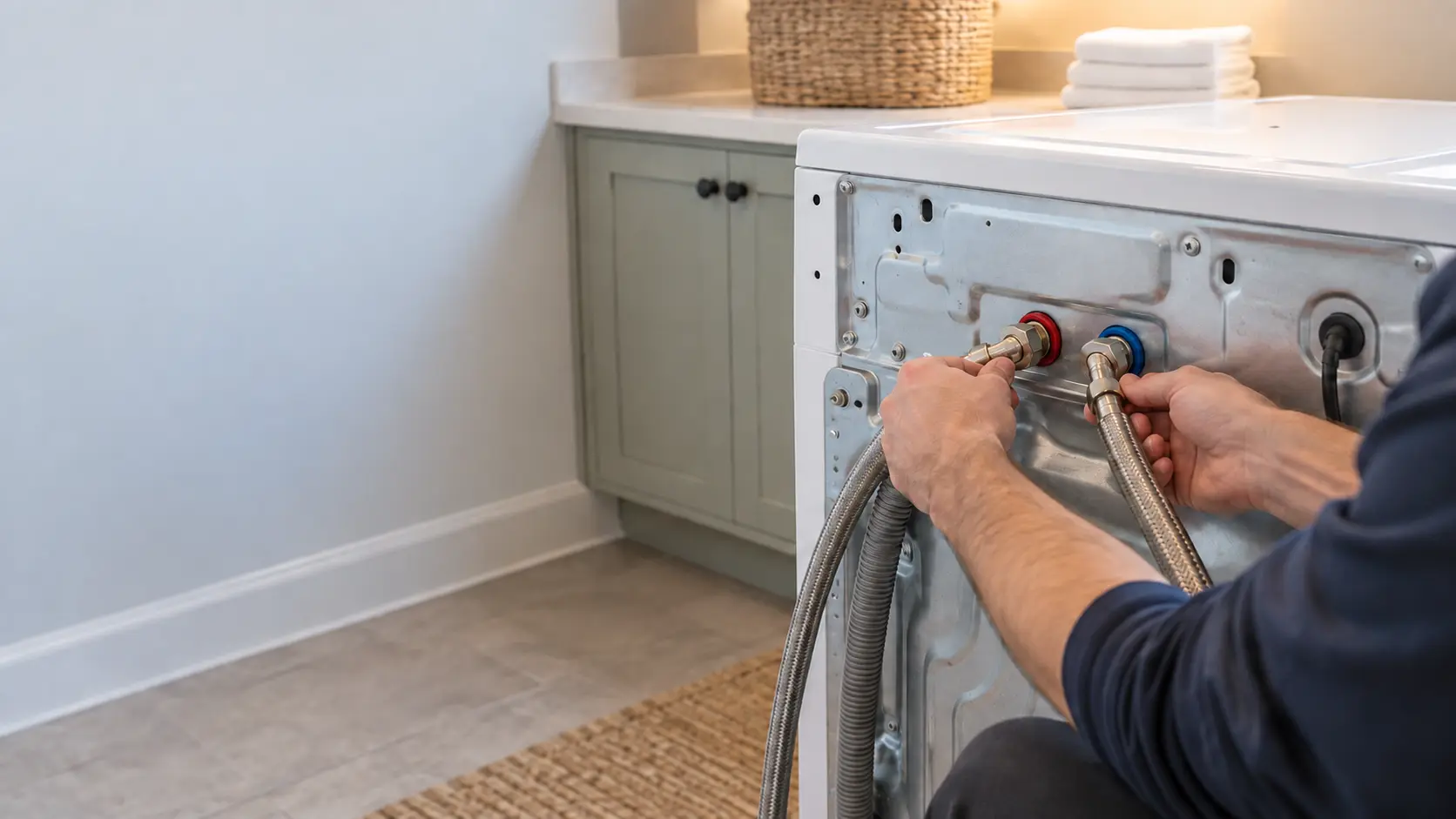
GE's standard hoses are 4 feet long with 3/4-inch connections, and longer ones can be bought where the valves sit far from the machine. Choose a length that lets the hoses curve gently behind the washer with the machine pushed back. Too long invites loops that kink; too short pulls on the fittings every time the washer is moved.
The inlet screens behind the hoses
Where each hose meets the washer, a small mesh screen sits inside the inlet port to catch grit and scale. When the hoses come off, it is the time to look at the screens. Whirlpool's advice is to clean them in place with an old toothbrush and mild soap and water, without removing the screens or pushing them out of position. A clogged screen shows up as slow filling or a fill error.
Source: Whirlpool Product Help — Checking the fill hoses if the washer is not filling — Fill hoses should be replaced every five years; clean clogged inlet screens with a brush and mild soap without removing them
Replacing washer fill hoses yourself
Swapping washer fill hoses is within reach of most owners, as long as the supply valves close fully. GE advises against adding check valves in the hose line, since they can restrict the flow the washer is designed around.
Set everything out before the valves close, because the job goes quickly once the water is off:
- A new pair of hoses of the right length, with a flat rubber washer seated inside each coupling.
- A bucket or a shallow tray and two old towels for the water left in the hoses.
- Slip-joint pliers, used gently on the couplings.
- A flashlight for the valves and the ports behind the machine.
- A marker and tape to write the install date on each new hose.
Source: GE Appliances — Washer inlet fill hoses — Replace hoses every 5 years; hoses not included since August 2010 except compact, unitized and contract models; standard 4-foot hoses with 3/4-inch connections and stainless options; hot right, cold left facing the rear; check valves not recommended