
What you are looking at
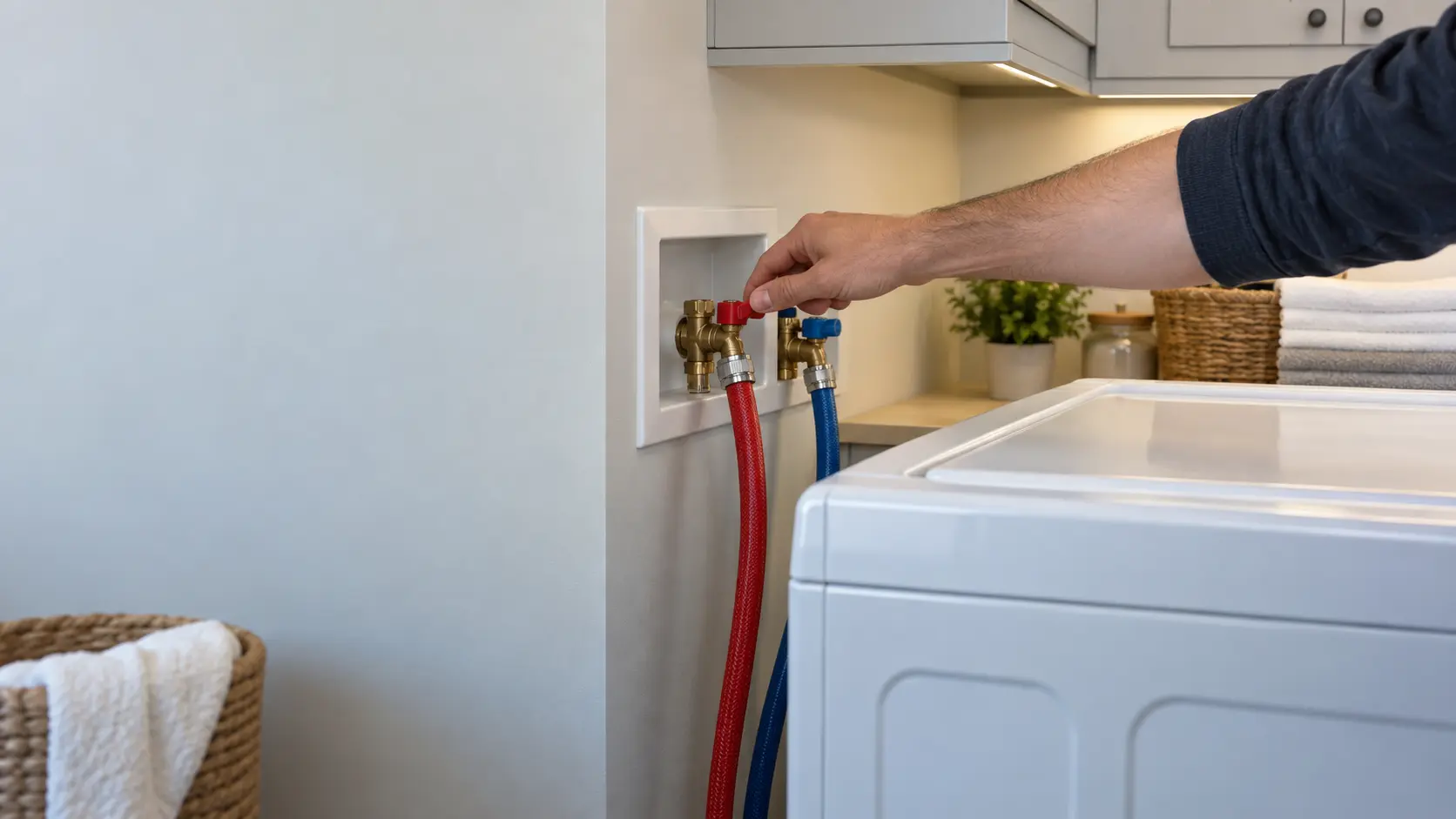
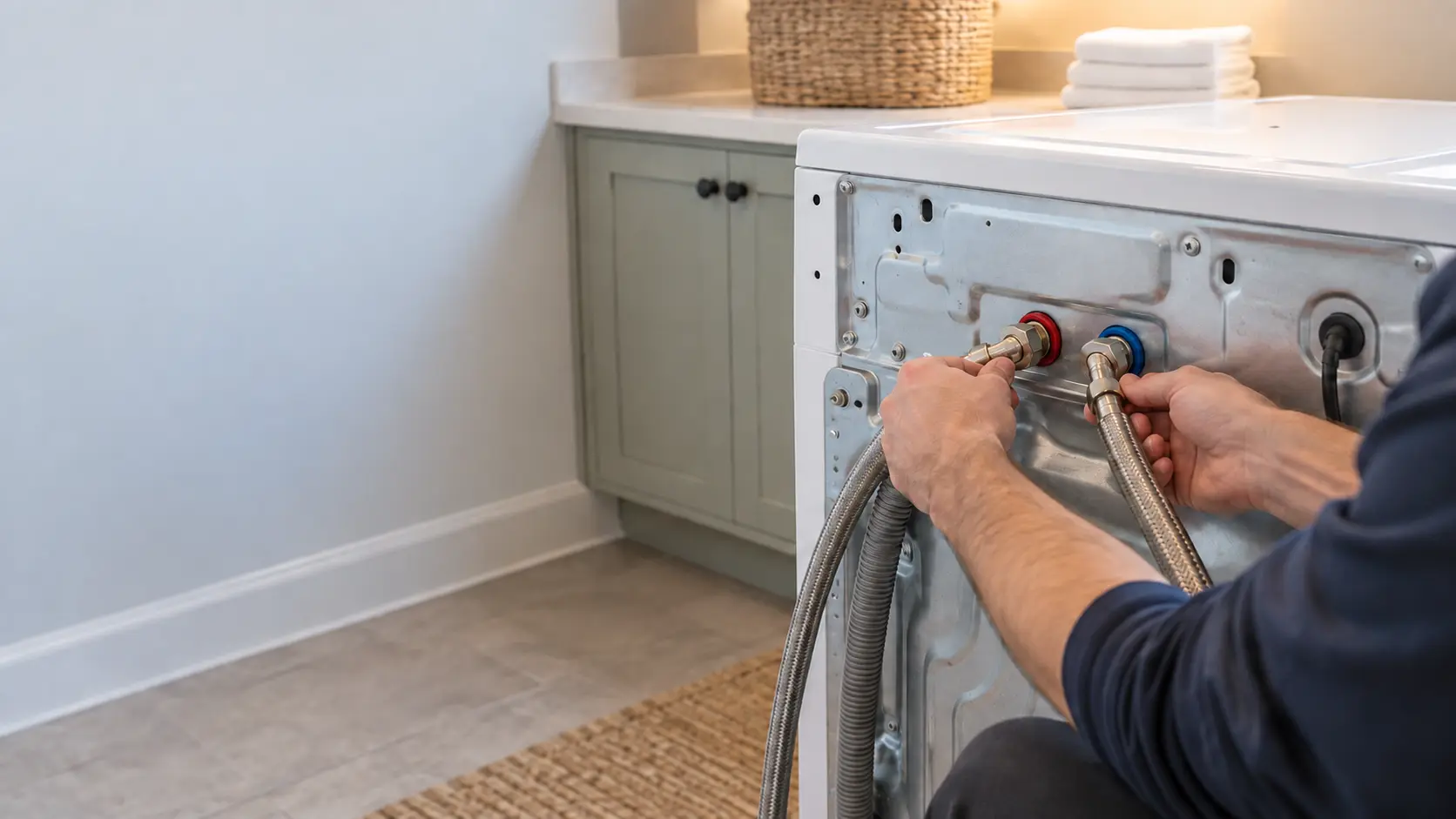
Behind almost every US washer, two washer shutoff valves come out of the wall or rise from pipes near the floor: hot on the left, cold on the right, often with red and blue marks. Each has a threaded spout that the fill hose screws onto. Speed Queen's instructions specify standard 3/4-inch garden-hose threads and rule out slip-on or clamp-on fittings. Whirlpool asks for the faucets to be within about 4 feet of the washer's fill valves, so the hoses do not have to stretch.
The kinds of valve you may have
Which of these you have decides how you close it and how much you can trust it after years of sitting open.
- Round handles that turn several times: the older multi-turn kind, closed clockwise until snug.
- Lever handles that move a quarter turn: ball valves, closed when the lever sits across the pipe.
- A single lever that closes hot and cold together: a dual shutoff, quick to reach in an emergency.
- A plastic box set into the wall with both valves and the drain opening inside it: a washer outlet box, common in newer homes and closets.
In a closet or behind a stacked pair
With a stacked washer and dryer, or a laundry closet with folding doors, the valves are often at chest height behind the dryer or hidden by the upper unit. Find them now, with a flashlight, rather than during a leak. If they cannot be reached without moving the appliances, the main house shutoff becomes the emergency valve, and everyone in the house should know where it is.
Source: Alliance Laundry Systems (Speed Queen) — Installation Instructions for Topload Washers, 204104 — 3/4-inch garden-hose faucets, no slip-on or clamp-on; 20 to 120 psi, slow fill below 20; inlet water at most 125°F; flush lines for about two minutes; Whirlpool Product Help — Electrical supply needed for a washer — Faucets within 4 feet of the fill valves; 20 to 100 psi; water heater at 120°F
When to close them
A fill hose holds full house pressure every hour the valves are open, whether the washer is running or not. That is why the manufacturers' advice is stricter than most owners' habits.
- At the end of each wash day, as Speed Queen's safety instructions ask.
- Before a vacation or any long absence, which LG and Speed Queen both recommend.
- Before disconnecting, replacing or tightening a fill hose.
- Before the washer is pulled out, moved or delivered.
- The moment water appears where it should not.
Source: Alliance Laundry Systems (Speed Queen) — User's Guide for Frontload Washers, 808187 — Close the shut-off valves at the end of each wash day; turn off the water for extended non-use; hydrogen gas after two weeks unused; LG Electronics — Washer Owner's Manual (WM4080) — Turn off the faucets and unplug for vacations; hydrogen gas warning for an unused hot-water system

Pressure, temperature and both valves open
A washer is designed around a range of water pressure. Whirlpool gives 20 to 100 psi; Speed Queen's top-load instructions allow 20 to 120 psi and note that pressure below 20 makes fills slow. Pressure above the range strains hoses and inlet valves, and only a plumber can confirm it with a gauge and adjust a pressure-reducing valve on the house supply.
Both valves need to be open fully even when you wash in cold. Whirlpool explains that its washers need incoming pressure from both hoses to finish a cycle. For temperature, Whirlpool suggests a water heater set to 120°F, and Speed Queen recommends inlet water no hotter than 125°F.
After the hot water has sat unused
LG and Speed Queen carry the same warning: a hot-water system unused for two weeks or more can collect hydrogen gas, which is explosive. Before running the washer after a long absence, open every hot faucet in the house and let it run for several minutes, with no smoking or open flame nearby.
After new plumbing or a remodel
Speed Queen asks installers to run the supply lines for about two minutes before connecting the hoses, so solder, sand and pipe debris do not end up on the screens inside the washer's inlet valve. A washer that fills slowly just after plumbing work often has exactly that problem.
Source: Alliance Laundry Systems (Speed Queen) — Installation Instructions for Topload Washers, 204104 — 3/4-inch garden-hose faucets, no slip-on or clamp-on; 20 to 120 psi, slow fill below 20; inlet water at most 125°F; flush lines for about two minutes; Whirlpool Product Help — Electrical supply needed for a washer — Faucets within 4 feet of the fill valves; 20 to 100 psi; water heater at 120°F; Whirlpool Product Help — Front load washer installation checklist — Both hot and cold water must be connected and turned on for the washer to complete a cycle
Valves that stick, drip or will not close
A valve that stays open for years can seize. Forcing it with a wrench can snap the handle or crack the valve body, which turns a slow problem into a fast one. A multi-turn valve may also start dripping at the stem, just below the handle, the first time it is turned after a long while.
Turning each valve closed and open again every few months keeps it free and tells you it still works. If it does not stop the flow completely, or weeps at the stem after you use it, close the main shutoff and call a plumber. Replacing a valve or a wall box is work on the house supply, not on the washer.